
French mules: between official records and regional traditions


The mule is not a breed in the traditional sense, but the result of a cross between a donkey (jack) and a mare. Its classification therefore relies not on a reproducible genealogy, but on a precise definition of authorized crosses.
Today, two types of mules benefit from official recognition, while other regional traditions—still very much alive—remain without a structured framework.
The two officially recognized registers
The Poitevin mule (mulassier type)
The Poitevin mule represents the historic French model, originating from the mule-breeding cradle of Poitou.
Strict cross:
Sire: Baudet du Poitou (Poitou donkey)
Dam: Poitevin draft mare (Trait poitevin mulassier)
System characteristics:
Highly regulated breeding scheme
Clearly defined parent breeds
Objective: preserving a consistent type (the homogeneous Poitevin mule)
This model is based on preserving a complete traditional breeding system, where each component (donkey, mare, mule) is inseparable.

The Pyrenean mule
The Pyrenean mule is part of a more recent effort of recognition and territorial promotion.
Basic cross:
Sire: Pyrenean donkey
Dam: rustic or draft-type mare
👉 Commonly used mares include:
Mérens
Breton draft
Percheron
Castillonnais
Anglo-Arab
Specific features:
More flexible model than the Poitevin system
Adapted to real-world field conditions
Focus on hardiness, versatility, and functionality
This register is based on promoting a type suited to its territory, with greater flexibility in breeding choices.

A shared framework
These two registers:
Are recognized by the French Ministry of Agriculture
Are monitored by the French Horse and Riding Institute (IFCE)
Are supported by breeding organizations
Key point: Unlike horses, the mule is sterile. There is therefore no studbook in the reproductive sense, but rather a regulated framework of crosses used to define types.
Traditions without a register
The Alpine mule
In the Alps, a mule-breeding tradition persists, notably in:
The two Savoie regions
The Seyne-les-Alpes area (Alpes-de-Haute-Provence)
Characteristics of these practices:
Predominant use of Comtois mares
Relatively homogeneous types depending on the area (Savoie, Flumet, Seyne…)
Local distinctions (bay coat, flaxen mane, etc.)
Use of Poitou or local donkey sires
Current challenges:
Over 20 years of reflection on creating a label
Absence of a register due to the impossibility of genealogy
Ongoing search for a shared identity
Despite this, the tradition remains alive and coherent, and is gradually becoming more structured.

The Massif Central: a revival underway
Long somewhat diffuse, mule production is now experiencing renewed interest in the Massif Central.
Driven by: the Massif Central Mule Breeding Association
Observed crosses:
Donkeys: Catalan donkey, Bourbonnais donkey
Mares:
Auvergne horse
Comtois
Ardennes, Auxois, and Trait du Nord draft breeds
Specific feature: These crosses rely on breeds historically present in the region, following a logic of local consistency.
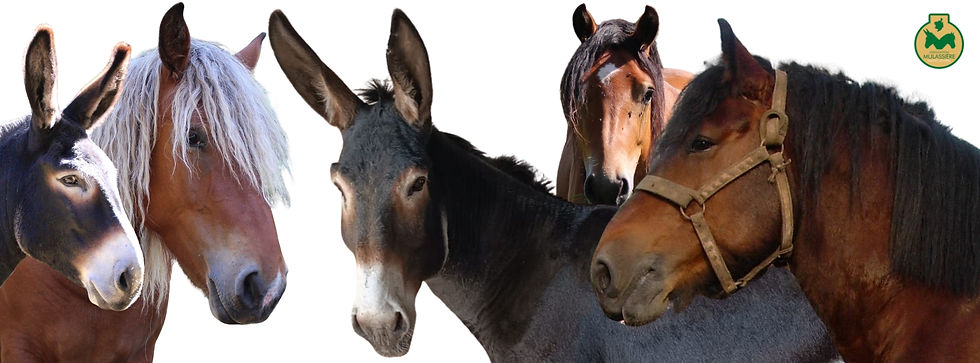
An intermediate territory
Certain areas, such as Ardèche (Girard breeding), lie at the crossroads between Alpine and Massif Central influences, illustrating continuity of practices rather than strict divisions.

Conclusion: diversity in need of structure
Today, the French mule sector is based on three realities:
A highly regulated system (Poitou)
A recognized but more flexible system (Pyrenees)
Dynamic regions without official recognition (Alps, Massif Central)
The question remains open: how can types be recognized, promoted, and structured… without genealogical support?
This diversity is the richness of France’s mule-breeding heritage—balancing tradition, adaptation, and the construction of new identities.


Comments